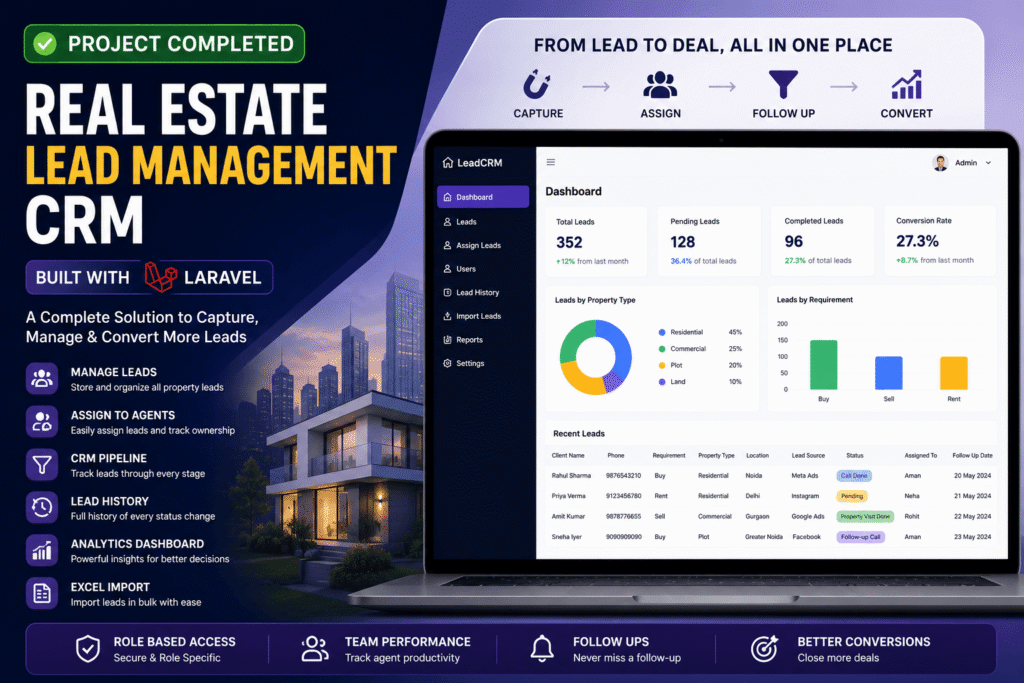
Real Estate Lead Management CRM
Managing real estate leads manually through spreadsheets, WhatsApp chats, and scattered notes quickly becomes messy. Agents miss follow-ups, leads get duplicated, and managers lose visibility into performance.
To solve this, I built a Real Estate Lead Management CRM using Laravel — a centralized system to capture, organize, assign, and track leads from first inquiry to final conversion.
What This CRM Does
This system helps real estate teams manage their complete lead workflow in one place.
Key Features
Lead Management
Store and manage all lead information including:
- Client details
- Contact information
- Property type
- Budget
- Location
- Requirement (Buy / Sell / Rent)
- Notes
- Follow-up dates
Lead Assignment
Assign leads directly to team members and track ownership.
- Super Admin can assign leads to agents
- Agents can manage only their assigned leads
- Auto lead ownership tracking
Lead Source Tracking
Track where leads are coming from:
- Meta Ads
- Google Ads
- Calls
- Personal referrals
- Custom sources
This helps identify which channels generate better conversions.
CRM Pipeline Tracking
Track every lead through a structured sales workflow:
- Pending
- Call Done
- Property Visit Done
- Follow-up Call
- Uploaded to Website
- Completed
- Cancelled
This creates a clear and standardized sales pipeline.
Lead History Tracking
Every status change is recorded automatically.
Tracks:
- Previous status
- New status
- Timestamp
This provides a full lead progression history for better reporting and accountability.
Analytics Dashboard
Visual insights for better decision-making:
- Total leads
- Pending leads
- Completed leads
- Conversion rate
- Property type stats
- Buy / Sell / Rent distribution
- Recent leads overview
Excel Import
Bulk import leads directly from Excel files.
Useful for migrating old spreadsheet data into the CRM quickly.
How It Helps Real Estate Teams
This CRM solves common operational issues by:
- Reducing manual lead management
- Preventing missed follow-ups
- Improving team accountability
- Organizing lead pipelines
- Tracking agent performance
- Improving conversion visibility
Instead of managing leads across multiple spreadsheets and chats, teams can now work from one centralized system.
Live